

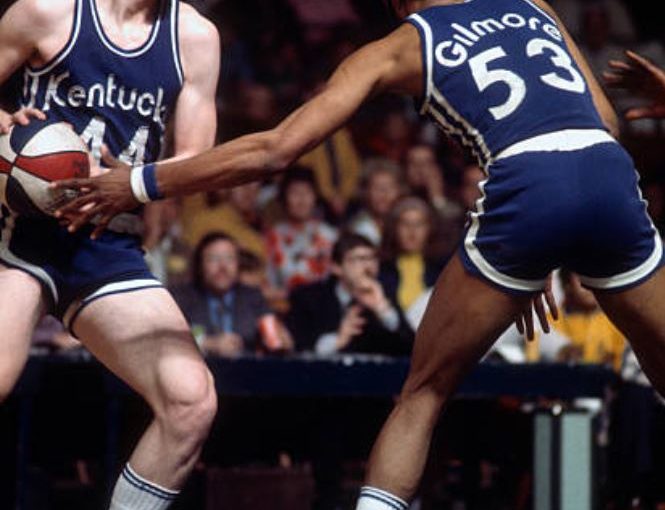
The Kentucky Colonels were one of the most successful and recognizable franchises in the history of the American Basketball Association. Based in Louisville, the Colonels competed during all nine seasons of the ABA, from 1967-68 through 1975-76. They won 448 regular-season games, reached the playoffs every year, appeared in the ABA Finals three times, and captured the 1975 ABA championship.
Despite their winning tradition, strong attendance, talented roster, and championship pedigree, the Colonels were not included among the four ABA franchises admitted into the National Basketball Association in 1976. The team was dissolved after the merger agreement, making the Colonels one of the most accomplished major professional basketball franchises ever to cease operations.
The Formation of the Kentucky Colonels
The American Basketball Association was organized in 1967 as a challenger to the established NBA. Louisville was selected as one of the new league’s original markets because of Kentucky’s passion for basketball and the absence of an NBA franchise in the state.
The team was named the Kentucky Colonels, drawing from the honorary title traditionally associated with the Commonwealth of Kentucky. The organization initially adopted chartreuse and white as its colors, giving the franchise one of the most distinctive visual identities in professional basketball.
The Colonels played their first three seasons at the Louisville Convention Center. Beginning with the 1970-71 season, they moved into the larger Freedom Hall, an arena already famous for hosting University of Louisville basketball and major college basketball events.
Kentucky and the Indiana Pacers became the only two ABA franchises to compete during all nine years of the league without relocating, changing their names, or folding before the final season.
The First Kentucky Colonels
The Colonels played their first game during the inaugural 1967-68 ABA season. John Givens began the year as head coach, but Gene Rhodes replaced him after the team opened with a 5-12 record.
Rhodes helped stabilize the expansion franchise and guided Kentucky to a 36-42 record. That was enough to earn fourth place in the Eastern Division and a spot in the first ABA Playoffs.
The early Colonels were led by guard Louie Dampier, forward Darel Carrier, center Goose Ligon, and guard Randolph Mahaffey. Dampier and Carrier quickly became two of the best long-range shooters in the new league.
Kentucky faced the Minnesota Muskies in the 1968 Eastern Division Semifinals. The Colonels pushed the 50-win Muskies to a deciding fifth game before losing the series three games to two.
Louie Dampier and Darel Carrier
Louie Dampier became the most enduring player in Colonels history. A former University of Kentucky star, Dampier joined the team during its first season and remained with the franchise throughout its entire nine-year existence.
Dampier was a talented scorer, ball-handler, passer, and outside shooter. The ABA’s three-point line suited his game perfectly, and he became one of the leading three-point shooters of the league’s early years.
Darel Carrier formed a dangerous backcourt combination with Dampier. Carrier was one of the ABA’s most accurate shooters and regularly ranked among the league leaders in three-point field goals and free-throw percentage.
Together, Dampier and Carrier gave the Colonels a strong Kentucky identity and helped build a loyal following throughout Louisville and the surrounding region.
The 1968-69 Season
The Colonels improved to 42-36 during their second season and finished third in the Eastern Division. Dampier averaged more than 24 points per game, while Carrier, Ligon, Mahaffey, and Wayne Chapman contributed to one of the league’s most productive offenses.
Kentucky faced the Indiana Pacers in the Eastern Division Semifinals. The series marked the beginning of what became one of the ABA’s most intense rivalries.
Indiana defeated Kentucky four games to three. The competitive series established the Colonels and Pacers as regional rivals who would meet repeatedly in important regular-season and playoff games.
The Colonels-Pacers Rivalry
The rivalry between the Kentucky Colonels and Indiana Pacers became one of the defining matchups of the ABA. The teams represented neighboring basketball-rich states and frequently competed for control of the Eastern Division.
The rivalry featured numerous prominent players, including Louie Dampier, Dan Issel, Artis Gilmore, Roger Brown, Mel Daniels, Freddie Lewis, and George McGinnis.
Kentucky and Indiana met in several postseason series, including the 1973 and 1975 ABA Finals. Their games frequently attracted large crowds and generated an atmosphere comparable to many established NBA rivalries.
The 1969-70 Season
Kentucky continued improving during the 1969-70 season. The Colonels finished 45-39 and again qualified for the playoffs.
Louie Dampier remained the team’s offensive leader, while Darel Carrier continued providing outside shooting. Goose Ligon supplied rebounding and interior strength.
The Colonels faced the New York Nets in the Eastern Division Semifinals but lost the series four games to three. It was the third consecutive season in which Kentucky was eliminated during the opening round.
The Arrival of Dan Issel
The direction of the franchise changed dramatically when Kentucky signed Dan Issel before the 1970-71 season. Issel had become one of the greatest players in University of Kentucky history while playing for coach Adolph Rupp.
Issel was also selected by the Detroit Pistons in the 1970 NBA Draft, but he chose to remain in Kentucky and sign with the Colonels. His decision gave the ABA another major young star and provided the Colonels with a hometown attraction capable of drawing fans throughout the state.
Issel immediately became one of professional basketball’s most productive scorers. He averaged 29.9 points and 13.2 rebounds per game during his rookie season and led the ABA in total points.
He was named the ABA Rookie of the Year and selected to the All-ABA First Team. Issel also shared ABA All-Star Game Most Valuable Player honors with Mel Daniels.
A Difficult Regular Season
The Colonels experienced considerable coaching instability during the 1970-71 season. Gene Rhodes began the year as head coach before being replaced by former University of Kentucky star and professional basketball pioneer Alex Groza.
Groza was later replaced by former Boston Celtics star Frank Ramsey. Kentucky finished the regular season with a 44-40 record and placed second in the Eastern Division.
Although the Colonels had not dominated the regular season, the combination of Issel, Dampier, Carrier, Ligon, and Cincinnatus Powell gave the team enough talent to become a serious playoff threat.
The 1971 ABA Playoff Run
The Colonels defeated The Floridians four games to two in the Eastern Division Semifinals. Kentucky then faced the Virginia Squires in the division finals.
Virginia had finished the regular season with a 55-29 record and was led by rookie guard Charlie Scott. The Colonels overcame the favored Squires and won the series four games to two.
The victory sent Kentucky to the ABA Finals for the first time in franchise history.
The 1971 ABA Finals
The Colonels faced the Utah Stars in the 1971 ABA Finals. Utah was coached by Bill Sharman and led by center Zelmo Beaty, forward Willie Wise, and guard Ron Boone.
The championship series extended to the full seven games. Kentucky had an opportunity to win its first title, but Utah prevailed in the deciding game and captured the championship.
Despite the loss, the series established the Colonels as one of the ABA’s premier organizations. Dan Issel had emerged as a superstar, while Louie Dampier remained one of the league’s finest guards.
Signing Artis Gilmore
The Colonels added another franchise-altering player before the 1971-72 season when they signed center Artis Gilmore.
Gilmore had starred at Jacksonville University and helped lead the school to the 1970 NCAA championship game. The 7-foot-2 center was one of the most highly sought-after players entering professional basketball.
The Chicago Bulls selected Gilmore in the 1971 NBA Draft, but the Colonels persuaded him to join the ABA. His combination of size, strength, rebounding, shot-blocking, and scoring ability immediately made Kentucky one of the most talented teams in either professional league.
Gilmore averaged 23.8 points and a league-leading 17.8 rebounds per game during his first professional season. He was named both the ABA Rookie of the Year and ABA Most Valuable Player, becoming one of the rare players to win both awards in the same season.
The Frontcourt of Gilmore and Issel
Artis Gilmore and Dan Issel formed one of the greatest frontcourt combinations in professional basketball history.
Gilmore controlled the paint with his defense, rebounding, and physical strength. Issel could score near the basket, from midrange, and in transition. Their contrasting styles made them difficult for opponents to defend.
With Gilmore and Issel inside and Dampier directing the offense, the Colonels possessed three future Basketball Hall of Fame players in their starting lineup.
Kentucky finished the 1971-72 season with a 68-16 record. The 68 victories were the most in ABA history, and the Colonels finished 24 games ahead of the second-place Virginia Squires in the Eastern Division.
The Disappointing 1972 Playoffs
Despite producing the best regular season in ABA history, the Colonels suffered one of the league’s greatest playoff upsets.
Kentucky faced the New York Nets in the Eastern Division Semifinals. The Nets had finished the season with a losing record, but they defeated the Colonels four games to two.
The loss ended Kentucky’s historic season and demonstrated the unpredictable nature of the ABA Playoffs. A team that had won 68 regular-season games was eliminated in the opening round.
The 1972-73 Season
Joe Mullaney returned as head coach for the 1972-73 season. Kentucky finished 56-28, placing second in the Eastern Division behind the Carolina Cougars.
Gilmore, Issel, and Dampier continued to form the foundation of the team. The roster also included Walt Simon, Cincinnatus Powell, Rick Mount, Jim Bradley, and Chuck Williams.
Kentucky defeated the Virginia Squires four games to one in the Eastern Division Semifinals. The Colonels then overcame the Carolina Cougars in a seven-game division finals series.
The 1973 ABA Finals
The victory over Carolina sent Kentucky back to the ABA Finals, where the Colonels faced the Indiana Pacers.
The series matched two of the league’s deepest and most successful teams. Kentucky relied on Gilmore, Issel, and Dampier, while Indiana featured Mel Daniels, George McGinnis, Roger Brown, and Freddie Lewis.
The championship series required seven games. Indiana won the deciding contest and captured its third ABA title, leaving the Colonels with their second Finals defeat in three years.
Babe McCarthy Takes Over
Babe McCarthy became Kentucky’s head coach before the 1973-74 season. McCarthy had previously led the New Orleans Buccaneers and Memphis Pros and was known for his demanding coaching style.
The Colonels finished 53-31 and placed second in the Eastern Division. Kentucky ranked among the ABA’s best defensive teams, with Gilmore dominating the lane and the rest of the roster applying pressure throughout the court.
McCarthy was named ABA Coach of the Year, while Gilmore earned Most Valuable Player honors at the ABA All-Star Game.
Kentucky swept the Carolina Cougars in the opening round of the playoffs. However, the Colonels were then swept by Julius Erving and the eventual champion New York Nets in the Eastern Division Finals.
Hubie Brown Becomes Head Coach
Following the 1973-74 season, the Colonels hired Hubie Brown as head coach. Brown had worked as an NBA assistant and was known for his detailed preparation, defensive knowledge, and demanding practices.
Brown inherited a roster filled with talent but faced the challenge of turning regular-season success into a championship. He installed an aggressive defensive system and developed a deep rotation that could maintain pressure throughout each game.
The Colonels added important contributors such as Wil Jones, Ted McClain, Marv Roberts, Bird Averitt, and Ron Thomas. The team’s depth reduced the burden on Gilmore, Issel, and Dampier.
The 1974-75 Regular Season
Kentucky finished the 1974-75 regular season with a 58-26 record. The Colonels tied the defending champion New York Nets for first place in the Eastern Division.
A special tiebreaker game was held to determine the division champion. Kentucky defeated New York 108-99, giving the Colonels first place and home-court advantage in the playoffs.
The team was balanced at both ends of the floor. Gilmore remained one of basketball’s dominant centers, Issel provided reliable scoring and rebounding, and Dampier supplied veteran leadership in the backcourt.
The 1975 ABA Playoffs
The Colonels opened the 1975 playoffs against the Memphis Sounds. Kentucky overwhelmed Memphis and completed a four-game sweep.
The Spirits of St. Louis awaited Kentucky in the Eastern Division Finals. The Spirits had upset Julius Erving and the New York Nets in the previous round, but the Colonels won the series four games to one.
Kentucky advanced to the ABA Finals for the third time and once again faced the Indiana Pacers.
The 1975 ABA Championship
The 1975 ABA Finals became the defining moment in Kentucky Colonels history.
Kentucky won the opening game against Indiana before the Pacers tied the series. The Colonels then captured the next three games to win the championship four games to one.
The title was secured on May 22, 1975, when Kentucky defeated Indiana 110-105 at Freedom Hall. Artis Gilmore delivered one of the greatest championship performances in ABA history, recording 28 points and 31 rebounds in the deciding game.
Gilmore was named the ABA Playoffs Most Valuable Player. Dan Issel and Louie Dampier also produced double-doubles in the championship-clinching victory.
After years of playoff disappointment, the Colonels had finally won the ABA championship. The victory gave Kentucky its first modern major professional sports title.
The 1974-75 Championship Roster
| Player | Position | Role |
|---|---|---|
| Artis Gilmore | Center | Interior scorer, rebounder, and defensive anchor |
| Dan Issel | Forward/Center | Leading scorer and rebounder |
| Louie Dampier | Guard | Playmaker, outside shooter, and team leader |
| Wil Jones | Forward | Versatile scorer and defender |
| Ted McClain | Guard | Perimeter defender and ball-handler |
| Bird Averitt | Guard | Reserve scoring guard |
| Marv Roberts | Forward | Frontcourt depth and rebounding |
| Ron Thomas | Forward | Reserve forward and role player |
Dan Issel Is Sold
The Colonels made a controversial roster move following their championship season. Owner John Y. Brown Jr. agreed to sell Dan Issel’s contract to the Baltimore Claws for $500,000.
Baltimore failed to complete the payment as its franchise collapsed before the 1975-76 regular season. Issel was then sent to the Denver Nuggets.
The departure of the popular former University of Kentucky star angered many Colonels supporters. Issel had been one of the most important players in franchise history and had helped connect the professional team with Kentucky’s college basketball audience.
Kentucky also sent defensive standout Ted McClain to the New York Nets in another financially motivated transaction.
The ABA’s Final Season
The ABA entered the 1975-76 season in severe financial difficulty. The Baltimore Claws folded before playing a regular-season game, while the San Diego Sails and Utah Stars ceased operations during the season. The Virginia Squires completed the schedule but folded before the merger negotiations were finalized.
Despite losing Issel and McClain, the defending champion Colonels remained competitive. Kentucky finished the regular season with a 46-38 record under Hubie Brown.
The ABA eliminated its traditional division format because so few teams remained. Kentucky finished fourth in the seven-team league.
The Final Kentucky Colonels Playoff Run
Kentucky faced the Indiana Pacers in a best-of-three opening-round series during the 1976 ABA Playoffs. The Colonels defeated their longtime rivals two games to one.
The victory sent Kentucky into the ABA Semifinals against the Denver Nuggets and former Colonels star Dan Issel.
The series went the full seven games. Denver won the deciding contest, bringing Kentucky’s title defense and franchise history to an end.
The final game was played on April 28, 1976. At the time, players and fans did not know with certainty that the Colonels would never play again.
The ABA-NBA Merger
After the 1975-76 season, the six surviving ABA organizations entered negotiations with the NBA.
The NBA agreed to admit four teams:
- Denver Nuggets
- Indiana Pacers
- New York Nets
- San Antonio Spurs
The Kentucky Colonels and Spirits of St. Louis were excluded from the agreement. Both franchises were dissolved, and their players were made available to NBA teams through a dispersal draft.
Kentucky’s exclusion was especially controversial because the Colonels had the best overall regular-season record in ABA history, had reached the playoffs in all nine seasons, and had won the championship only one year earlier.
Why the Colonels Did Not Join the NBA
Several factors contributed to Kentucky’s exclusion from the NBA.
The NBA already had teams in several nearby Midwestern markets, including the Chicago Bulls, Cleveland Cavaliers, and Detroit Pistons. Some established NBA owners were concerned about territorial conflicts and the addition of another relatively small market.
The Chicago Bulls reportedly opposed the admission of Kentucky and hoped to acquire Artis Gilmore through a dispersal draft. Gilmore would ultimately join Chicago after the Colonels folded.
John Y. Brown Jr. also accepted a reported $3 million payment in exchange for dissolving the franchise. Unlike the owners of the Spirits of St. Louis, who negotiated a continuing share of television revenue, Brown chose an immediate cash settlement.
The decision ended major professional basketball in Louisville despite the Colonels’ strong competitive history.
The Dispersal Draft
After the franchise was dissolved, Kentucky’s players were distributed among NBA teams.
Artis Gilmore was selected by the Chicago Bulls. Louie Dampier joined the San Antonio Spurs, allowing him to continue with one of the former ABA franchises entering the NBA.
Wil Jones was selected by the Indiana Pacers, while other Colonels players were acquired by teams throughout the NBA.
Hubie Brown became head coach of the Atlanta Hawks and went on to have a long career as a coach, television analyst, and Basketball Hall of Fame contributor.
Kentucky Colonels Season-by-Season Results
| Season | Wins | Losses | Win Percentage | Playoff Result | Head Coach |
|---|---|---|---|---|---|
| 1967-68 | 36 | 42 | .462 | Lost Eastern Division Semifinals | John Givens and Gene Rhodes |
| 1968-69 | 42 | 36 | .538 | Lost Eastern Division Semifinals | Gene Rhodes |
| 1969-70 | 45 | 39 | .536 | Lost Eastern Division Semifinals | Gene Rhodes |
| 1970-71 | 44 | 40 | .524 | Lost ABA Finals | Gene Rhodes, Alex Groza, and Frank Ramsey |
| 1971-72 | 68 | 16 | .810 | Lost Eastern Division Semifinals | Joe Mullaney |
| 1972-73 | 56 | 28 | .667 | Lost ABA Finals | Joe Mullaney |
| 1973-74 | 53 | 31 | .631 | Lost Eastern Division Finals | Babe McCarthy |
| 1974-75 | 58 | 26 | .690 | Won ABA Championship | Hubie Brown |
| 1975-76 | 46 | 38 | .548 | Lost ABA Semifinals | Hubie Brown |
| Total | 448 | 296 | .602 | 9 playoff appearances and 1 championship |
Kentucky Colonels ABA Finals Appearances
| Year | Opponent | Result |
|---|---|---|
| 1971 | Utah Stars | Lost series, 4-3 |
| 1973 | Indiana Pacers | Lost series, 4-3 |
| 1975 | Indiana Pacers | Won series, 4-1 |
Notable Kentucky Colonels Players
Louie Dampier
Louie Dampier played all nine ABA seasons with the Colonels and became the franchise’s career leader in games, points, assists, and several other categories. He was a seven-time ABA All-Star and one of the league’s greatest outside shooters. Dampier was inducted into the Basketball Hall of Fame in 2015.
Artis Gilmore
Artis Gilmore joined Kentucky in 1971 and immediately won ABA Rookie of the Year and Most Valuable Player honors. He became the league’s dominant interior player and led the Colonels to the 1975 championship. Gilmore was inducted into the Basketball Hall of Fame in 2011.
Dan Issel
Dan Issel was one of the ABA’s premier scorers and rebounders. The former University of Kentucky star played five seasons with the Colonels and helped the team reach three ABA Finals. He was inducted into the Basketball Hall of Fame in 1993.
Darel Carrier
Darel Carrier was one of the ABA’s first great three-point shooters. He played five seasons for Kentucky and formed a productive early backcourt with Dampier.
Goose Ligon
Goose Ligon provided rebounding, strength, and physical play during the Colonels’ early seasons. He became one of the most popular and dependable players on the original Kentucky teams.
Wil Jones
Wil Jones was a versatile forward who contributed scoring, rebounding, and defense to the 1975 championship team.
Notable Kentucky Colonels Coaches
Gene Rhodes
Gene Rhodes coached the Colonels during much of their first four seasons and helped transform the expansion team into a regular playoff participant.
Frank Ramsey
Former University of Kentucky and Boston Celtics star Frank Ramsey took over during the 1970-71 season and guided the Colonels to their first ABA Finals appearance.
Joe Mullaney
Joe Mullaney coached Kentucky to the ABA-record 68-win season in 1971-72 and returned the team to the Finals in 1973.
Babe McCarthy
Babe McCarthy led the Colonels to a 53-31 record during the 1973-74 season and was named ABA Coach of the Year.
Hubie Brown
Hubie Brown guided Kentucky to its only championship in 1975. His demanding defensive system and use of a deep rotation helped the Colonels finally convert their talent into a league title.
Franchise Records and Accomplishments
- Played all nine seasons of the American Basketball Association.
- Compiled a regular-season record of 448-296.
- Recorded the highest regular-season winning percentage in ABA franchise history.
- Qualified for the playoffs in all nine seasons.
- Won an ABA-record 68 regular-season games in 1971-72.
- Reached the ABA Finals in 1971, 1973, and 1975.
- Won the 1975 ABA championship.
- Featured Hall of Fame players Louie Dampier, Dan Issel, and Artis Gilmore.
- Featured Hall of Fame coaches Frank Ramsey and Hubie Brown.
The Legacy of the Kentucky Colonels
The Kentucky Colonels were among the finest organizations in ABA history. They combined local stars, Hall of Fame talent, strong attendance, colorful personalities, and sustained success on the court.
The franchise’s greatest teams featured three future Hall of Famers in Louie Dampier, Dan Issel, and Artis Gilmore. Together, they helped Kentucky reach two ABA Finals and formed the foundation of the 1975 championship team.
The Colonels also gave Kentucky its first lasting major professional basketball franchise. Their games at Freedom Hall became an important part of Louisville’s sports culture, particularly during the intense rivalry with the Indiana Pacers.
The decision to exclude Kentucky from the NBA remains one of the most debated outcomes of the ABA-NBA merger. The Colonels had won more games than any other ABA franchise and had captured a championship only one season before they were dissolved.
Although the Colonels disappeared in 1976, their influence continued through the players and coaches who moved into the NBA. Gilmore became an NBA All-Star with Chicago, Dampier continued with San Antonio, Issel starred for Denver, and Hubie Brown became one of basketball’s most respected coaches and broadcasters.
The Kentucky Colonels remain a symbol of both the greatness and instability of the ABA. They were successful enough to become champions but were still unable to survive the business negotiations that ended the league. Their nine seasons, 448 victories, three Finals appearances, and 1975 championship ensure that the Colonels hold a permanent place in professional basketball history.