

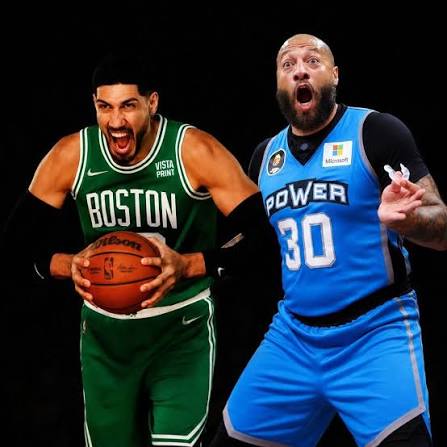
Former NBA players Royce White and Enes Kanter Freedom have found a new way to put themselves back into the basketball conversation: announcing plans to enter the 2027 WNBA Draft.
Neither announcement should be confused with the ordinary situation of a transgender athlete seeking to participate in sports consistent with her gender identity. White and Freedom are making a political and rhetorical point about transgender eligibility rules in women’s sports. Their announcements are deliberately designed to test where the WNBA draws the line.
That distinction matters, because otherwise an obvious publicity stunt gets turned into a caricature of transgender athletes themselves.
Still, as basketball theater, the whole thing is difficult to take seriously.
Two Former NBA Players Suddenly Want Into the WNBA
Freedom announced in August 2026 that he intends to declare for the 2027 WNBA Draft, arguing that the league’s eligibility language allows him to do so.
Royce White quickly followed with his own announcement. White said he identifies as transgender “for purposes of professional basketball” and intends to enter the 2027 WNBA Draft.
That wording tells you virtually everything you need to know about the seriousness of the exercise.
These are not two athletes describing longstanding transitions and asking how existing eligibility standards apply to them. They are former NBA players intentionally pushing the WNBA’s rules to an absurd extreme in an attempt to make a political point.
The problem is that the stunt may say considerably more about White and Freedom than it does about women’s basketball.
Royce White’s WNBA Plan Has One Particularly Ironic Problem
Of the two announcements, Royce White’s may be the strangest from a purely basketball perspective.
White was the 16th overall selection in the 2012 NBA Draft after an outstanding season at Iowa State. He was an unusually versatile 6-foot-8 forward who could rebound, handle the ball and create for teammates.
On talent alone, White looked like an intriguing NBA prospect.
But his professional career became dominated by something entirely different: his severe anxiety disorder and, most famously, his fear of flying.
The NBA Is a League Built Around Air Travel
White was open about his mental-health struggles before and after the draft. One of his greatest difficulties was air travel.
That presented an enormous logistical problem because NBA teams routinely fly thousands of miles during the season.
White sought accommodations that would allow him to travel by bus for some games and became involved in a prolonged dispute with the Houston Rockets over how his condition should be managed.
His fear of flying was not the sole reason his NBA career failed. His disagreements with Houston over medical protocols, missed team activities, limited opportunities and other circumstances all played roles.
But there is no question that travel-related anxiety became one of the defining complications of his NBA career.
White Played Three NBA Games
Despite being a first-round draft pick, White never played a regular-season game for Houston.
He eventually reached the NBA with the Sacramento Kings in 2014.
His NBA career consisted of just three games.
That makes his sudden interest in the WNBA especially ironic.
The WNBA does not play its schedule in one building.
WNBA teams fly, too.
So White is now talking about joining another professional basketball league built around the same fundamental travel requirement that became such a significant obstacle during his first attempt at an NBA career.
Unless the 2027 WNBA schedule includes a revolutionary 3,000-mile team bus route, White would eventually encounter exactly the logistical reality he faced in the NBA: professional basketball teams have to get on airplanes.
Enes Freedom’s Argument Has a Different Kind of Irony
Enes Kanter Freedom’s story is dramatically different.
Unlike White, Freedom had a substantial NBA career. He played for Utah, Oklahoma City, New York, Portland and Boston and spent more than a decade in the league.
He was also involved in an extraordinary international political dispute with the government of Turkey.
Freedom became a vocal critic of Turkish President Recep Tayyip Erdoğan.
Turkey revoked his passport in 2017, and Freedom was temporarily detained while traveling through Romania because his travel documents had been invalidated. He eventually returned to the United States.
Turkish authorities later pursued criminal action against him, while his criticism of Erdoğan contributed to serious problems for members of his family.
Freedom eventually became a United States citizen in 2021 and legally added “Freedom” to his name.
Freedom Knows What Government Restrictions Actually Look Like
That history makes his transformation of the WNBA eligibility debate into a publicity stunt particularly uncomfortable.
Freedom has built much of his public identity around individual liberty.
He knows what it is like to have a government interfere with his ability to travel, threaten his liberty and punish him for expressing an identity or political viewpoint authorities dislike.
That does not mean he is required to support every claim made in the name of transgender rights. Nor does escaping political persecution automatically settle a complicated sports-policy question.
But there is an obvious tension between building a public persona around personal freedom and then using another small and frequently targeted group of people as the punch line in a political demonstration.
Freedom can argue that women’s sports should be organized according to biological sex. Plenty of athletes, lawmakers and voters agree with that position.
He does not need to pretend he wants to play in the WNBA to make the argument.
There Is a Real Debate About Transgender Athletes
Underneath the spectacle created by White and Freedom is a legitimate policy debate.
Women’s sports exist as a separate competitive category because male and female athletic performance diverges significantly, particularly after puberty.
Supporters of sex-based eligibility rules argue that allowing athletes who experienced male puberty to compete in female categories can create competitive advantages involving height, skeletal structure, strength, speed and other physical characteristics.
Supporters of transgender inclusion counter that transgender athletes deserve meaningful opportunities to participate in sports and argue that eligibility can be addressed through carefully constructed policies rather than categorical exclusion.
Different governing bodies have tried different approaches over the years, including hormone requirements, testosterone limits, transition periods and sex-at-birth classifications.
There is no need to pretend the debate is simple.
There is also no need to pretend Royce White declaring himself a woman “for purposes of professional basketball” represents the ordinary transgender athlete.
It doesn’t.
The Rules Have Changed Dramatically
American sports policy regarding transgender athletes has shifted substantially during the 2020s.
For years, several athletic organizations permitted transgender women to compete in women’s categories after meeting hormone-related requirements.
Criticism of those policies grew as transgender participation became a national political issue.
By 2025, the NCAA had changed its policy.
The NCAA now restricts competition in women’s sports to student-athletes who were assigned female at birth. Athletes assigned male at birth may practice with women’s teams under certain circumstances but cannot compete in NCAA women’s competition.
Twenty-Seven States Have Passed Restrictions
State governments have also acted.
As of 2026, 27 states have enacted laws restricting transgender student-athletes from competing on school sports teams corresponding with their gender identity.
The details vary by state. Some laws apply primarily to K-12 athletics, while others extend into colleges and universities.
Those laws became the subject of major constitutional and Title IX litigation.
The Supreme Court Weighed In During 2026
On June 30, 2026, the United States Supreme Court issued a major decision involving transgender participation in girls’ and women’s sports.
The cases involved laws in West Virginia and Idaho that restricted participation in female athletic categories according to biological sex.
The Court upheld the states’ ability to maintain sex-based women’s and girls’ sports categories.
The ruling established that Title IX permits schools to maintain separate male and female athletic teams and that states may determine eligibility for female teams according to biological sex under the circumstances addressed by the cases.
What the Supreme Court Did Not Say
The ruling is important, but it should not be exaggerated.
The Supreme Court did not announce a nationwide rule requiring every sports organization in America to exclude every transgender woman.
Instead, the Court held that states may maintain women’s and girls’ sports for biological females without violating Title IX and, under the laws before the Court, the Equal Protection Clause.
That is an important distinction.
Professional leagues can have their own eligibility rules, subject to applicable law and collective bargaining agreements.
The WNBA Is Not the NCAA
The WNBA is a professional league, not a state school system or NCAA institution.
Its eligibility is governed by league rules and its collective bargaining agreement with the Women’s National Basketball Players Association.
The WNBA’s eligibility language has stated that only women are eligible to play in the league.
The controversy exposed by Freedom and White is that publicly available league language has not always provided the sort of detailed biological-sex or transgender eligibility definition found in newer NCAA and state policies.
That ambiguity is something the WNBA can address without turning White or Freedom into serious basketball prospects.
The WNBA Should Clarify Its Rule
If there is one useful consequence of this circus, it may be that the WNBA has an opportunity to write a clearer eligibility policy.
A professional sports league should not need to rely on assumptions when determining who qualifies for its protected competitive category.
If the league intends the WNBA to be a female-sex athletic category, it can say so explicitly.
If it intends to permit transgender women under specified conditions, it can publish those conditions.
Either approach would be more useful than leaving an important eligibility question ambiguous enough to invite publicity stunts.
Women’s Sports Deserve Serious Rules
Women’s professional basketball has fought for decades for legitimacy, investment, media coverage and respect.
The WNBA now has more attention, stronger attendance, increased television exposure and greater cultural relevance than at almost any point in its history.
Its eligibility standards therefore deserve to be written with the same seriousness as its salary cap, draft rules, roster regulations and collective bargaining provisions.
The answer should come from clear league policy, not from two retired NBA players trolling their way toward draft night.
Transgender Athletes Deserve a More Serious Debate Too
The other problem with the stunt is that transgender athletes themselves become props in someone else’s political argument.
A transgender high-school student trying to participate on a track team is not Royce White.
A transgender college athlete navigating NCAA rules is not Enes Freedom.
Those situations involve real people attempting to navigate eligibility policies that can determine whether they are allowed to participate in a sport they have trained for.
Reasonable people can disagree strongly about whether women’s competitive categories should be determined exclusively by biological sex.
That disagreement does not require pretending that a former NBA center suddenly announcing himself as a WNBA prospect is equivalent to an actual transgender athlete.
White’s Basketball Résumé Makes the Stunt Even Stranger
There is another irony in White presenting himself as a potential professional women’s basketball player.
His original NBA opportunity was substantial.
Houston spent the 16th overall pick on him.
First-round selections are given opportunities that thousands of professional basketball players never receive.
Yet White’s NBA résumé ultimately consists of three games.
More than a decade later, he is talking about returning to America’s highest level of women’s professional basketball.
Before worrying about whether the WNBA would allow him to play, there is a considerably more basic basketball question:
What WNBA team is supposed to want him?
Freedom Is Years Removed From the NBA
Freedom at least had a legitimate and productive NBA career.
At his best, he was an excellent rebounder and interior scorer.
But he has also been out of the NBA for years.
His WNBA declaration therefore has little resemblance to an authentic attempt at extending a professional basketball career.
It is political theater.
A Serious Issue Reduced to a Publicity Stunt
That is ultimately what makes the entire episode so ridiculous.
There are legitimate questions surrounding competitive fairness, biological sex, gender identity and transgender participation in women’s sports.
Courts are addressing them.
State legislatures are addressing them.
The NCAA has addressed them.
Athletic federations around the world are addressing them.
The WNBA should address them clearly as well.
But Enes Freedom and Royce White declaring for the WNBA Draft does almost nothing to advance that discussion.
Conclusion
Royce White and Enes Freedom are free to criticize transgender participation policies in women’s sports.
They can argue that women’s basketball should be restricted according to biological sex. They can point to the NCAA’s current rules, the laws adopted by 27 states and the Supreme Court’s 2026 decision permitting states to maintain sex-based girls’ and women’s athletic categories.
Those are substantive arguments.
Pretending to be WNBA Draft prospects is not.
For White, the spectacle is made even more absurd by his own NBA history. A first-round pick whose professional career was profoundly complicated by anxiety surrounding air travel is now talking about joining another national basketball league whose teams routinely travel by air.
For Freedom, the stunt carries a different irony. A man who knows firsthand what it means to have a government revoke his passport and restrict his freedom has every right to advocate sex-based athletic categories, but turning questions of identity and exclusion into a publicity stunt sits awkwardly beside the personal-freedom principles on which he has built much of his public reputation.
The WNBA can settle the relevant basketball question fairly easily: write an explicit eligibility rule and enforce it consistently.
Women’s sports deserve serious protection and serious policymaking.
Transgender athletes deserve to have the real arguments about their participation considered seriously rather than being reduced to a political punch line.
And the WNBA deserves better than becoming the stage for two former NBA players looking for another moment in the spotlight.