

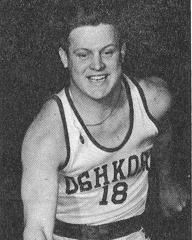

History of the Oshkosh All-Stars
The Oshkosh All-Stars were one of the most successful and historically important professional basketball teams of the pre-NBA era. Based in Oshkosh, Wisconsin, the club was founded in 1929 and developed from an independent barnstorming team into one of the dominant organizations of the National Basketball League.
Oshkosh competed in the NBL during all 12 seasons of the league’s existence from 1937-38 through 1948-49. The All-Stars reached the playoffs 11 times, appeared in the NBL championship series seven times and won back-to-back championships in 1941 and 1942.
The All-Stars also captured the prestigious 1942 World Professional Basketball Tournament, giving Oshkosh both the NBL championship and the tournament championship during the same season.
The franchise’s greatest players included Leroy Edwards, Gene Englund, Charley Shipp, Bob Carpenter, Herm Witasek, Connie Mack Berry, Eddie Riska, Lou Barle and Pete Preboske. Edwards was the defining star of the early dynasty, winning the first three NBL Most Valuable Player awards from 1938 through 1940.
Oshkosh finished its 12-year NBL run with a 225-170 regular-season record, two championships and one of the strongest postseason traditions in the league’s history.
The Beginning of Professional Basketball in Oshkosh
The Oshkosh All-Stars were founded in 1929 by local basketball promoter Alonzo “Lon” Darling.
The idea of creating a professional basketball team in Oshkosh was encouraged by local interest in the sport and by newspaper figures who believed a winter professional team could provide the city with an important athletic attraction.
Oshkosh was a relatively small Wisconsin city, but basketball was already popular throughout the region.
Darling assembled a team that began playing independent and barnstorming schedules against clubs from throughout Wisconsin and the Midwest.
Lon Darling
Lon Darling became the most important organizational figure in All-Stars history.
Darling operated the team, recruited players, arranged schedules and later served as head coach.
During an era when professional basketball organizations often lacked large management staffs, Darling filled many roles that would later be divided among owners, general managers and coaches.
His ability to keep a professional basketball team operating in a relatively small city for two decades was remarkable.
A Barnstorming Team
During the early 1930s, the All-Stars did not belong to a formal league.
Instead, they traveled throughout the region playing independent clubs, company teams, college alumni squads and other professional organizations.
Barnstorming was an essential part of early professional basketball.
Teams could build reputations by playing strong opponents in different cities rather than relying solely on league schedules.
The All-Stars gradually became recognized as one of the better independent teams in the Midwest.
George Hotchkiss
George Hotchkiss was one of the important early All-Stars.
The former University of Wisconsin athlete played for Oshkosh during the club’s independent years before becoming head coach.
Hotchkiss took over coaching responsibilities before the creation of the National Basketball League and eventually guided Oshkosh through its first four NBL seasons.
Under Hotchkiss, the All-Stars became one of the league’s first dynasties.
The New York Renaissance Series
One of the most important moments in the All-Stars’ pre-NBL history came through games against the famous New York Renaissance, commonly called the Rens.
The Rens were one of the greatest professional basketball teams of the era and one of the most important Black basketball organizations in American history.
Oshkosh first played the Rens in a major series during the middle of the 1930s.
The games attracted large crowds and demonstrated that a professional team from Oshkosh could draw substantial interest when facing nationally recognized opponents.
The “World Series of Basketball”
In 1937, Oshkosh and the Rens played a lengthy series that was promoted as a battle for professional basketball supremacy.
The competition became known informally as a “World Series of Basketball.”
The series helped raise the national profile of the All-Stars and convinced Darling that the team was capable of competing at the highest professional level.
That opportunity arrived later the same year.
The Creation of the National Basketball League
The National Basketball League began play during the 1937-38 season.
The league developed from the earlier Midwest Basketball Conference and consisted largely of company-sponsored and independent teams located in the industrial Midwest.
Oshkosh became one of the league’s original franchises.
The All-Stars would ultimately become one of only a few organizations to compete during every season of the NBL’s existence.
Leroy Edwards
The player who transformed Oshkosh into a championship contender was Leroy Edwards.
The 6-foot-5 center-forward had starred at the University of Kentucky and became one of the first dominant big men in professional basketball.
Edwards combined size, strength, scoring ability and sophisticated post play at a time when professional basketball was still developing strategies for using tall interior players.
He immediately became the centerpiece of the All-Stars.
The First NBL MVP
Edwards dominated the league during its inaugural season.
He scored 210 points in 13 games, averaging an extraordinary 16.2 points per game.
That scoring average was enormous during an era when many teams averaged fewer than 40 points.
Edwards led the NBL in scoring and was named the league’s first Most Valuable Player.
Three Consecutive MVP Awards
Edwards did not stop after one dominant season.
He won the NBL Most Valuable Player Award again in 1938-39 and 1939-40.
That gave Edwards the first three MVP awards in league history.
His dominance established him as one of the greatest professional basketball players of the pre-NBA era.
The 1937-38 Oshkosh All-Stars
Oshkosh immediately became one of the strongest teams in the new NBL.
The All-Stars finished the inaugural season with a spectacular 12-2 record.
Their .857 winning percentage was the best in the Western Division.
Oshkosh also led the entire league in scoring at 45.6 points per game.
First NBL Playoff Run
Oshkosh faced the Whiting Ciesar All-Americans in the Western Division playoffs.
The All-Stars swept Whiting and advanced to the first NBL championship series.
The opponent was the Akron Goodyear Wingfoots.
The 1938 NBL Finals
The inaugural championship series went three games.
Akron defeated Oshkosh two games to one.
The Wingfoots therefore became the first champions in NBL history.
For Oshkosh, the loss began a frustrating pattern of coming extremely close to a championship without finishing the job.
The 1938-39 All-Stars
Oshkosh remained one of the league’s elite teams during its second NBL season.
The All-Stars finished 17-11 and again placed first in the Western Division.
Edwards led the team with 334 points and averaged 11.9 points per game.
He repeated as league MVP.
Another NBL Finals Appearance
The All-Stars again advanced to the championship series.
This time the opponent was the Akron Firestone Non-Skids.
The series went the full five games.
Firestone defeated Oshkosh three games to two.
The All-Stars had now lost in the NBL Finals in each of the league’s first two seasons.
The 1939-40 Season
Oshkosh again finished first in the Western Division in 1939-40.
The All-Stars went 15-13.
Edwards scored 361 points, averaging 12.9 per game, and won his third consecutive NBL Most Valuable Player Award.
No player had dominated the young league more consistently.
Third Consecutive Finals Appearance
Oshkosh defeated the Sheboygan Red Skins in the Western Division playoffs and returned to the NBL championship series.
The opponent was once again Akron Firestone.
For the second consecutive season, the Finals went five games.
Firestone again defeated Oshkosh three games to two.
Three Straight Finals Losses
By the end of the 1939-40 season, Oshkosh had reached all three NBL championship series ever played.
They had lost all three.
Despite the disappointment, the consistency of the All-Stars was extraordinary.
The franchise had become the dominant regular-season organization in the Western Division.
The 1940-41 Breakthrough
The championship breakthrough finally arrived during the 1940-41 season.
Oshkosh finished 18-6, once again producing the best record in the league.
The All-Stars averaged 42.2 points while allowing only 37.1.
The team was balanced around Edwards and an increasingly deep supporting cast.
Charley Shipp
Charley Shipp became one of the most important players on the championship teams.
The versatile guard-forward provided scoring, defense and leadership.
Shipp earned First Team All-NBL honors and became one of the defining players of the All-Stars’ championship era.
Bob Carpenter
Bob Carpenter gave Oshkosh another strong interior presence.
Carpenter’s combination of size and scoring allowed the All-Stars to maintain physical control inside while Edwards remained the primary frontcourt star.
Carpenter later became recognized as one of the important players of the NBL era.
Herm Witasek
Herm Witasek became another long-time contributor.
The guard-forward played an important role in the balanced Oshkosh offense.
His versatility helped the All-Stars adapt to different opponents during their championship years.
The 1941 Playoffs
Oshkosh entered the postseason determined to end its championship frustration.
The All-Stars defeated the Akron Firestone Non-Skids in the semifinals.
The victory was particularly satisfying because Firestone had defeated Oshkosh in each of the previous two championship series.
The 1941 NBL Finals
Oshkosh faced the Sheboygan Red Skins in the championship series.
The All-Stars dominated.
Oshkosh swept Sheboygan in three games:
| Game | Result |
|---|---|
| Game 1 | Oshkosh 53, Sheboygan 38 |
| Game 2 | Oshkosh 44, Sheboygan 38 |
| Game 3 | Oshkosh 54, Sheboygan 36 |
First NBL Championship
After three consecutive Finals defeats, the Oshkosh All-Stars were finally NBL champions.
The 1941 championship became the defining achievement of the Hotchkiss coaching era.
George Hotchkiss was named NBL Coach of the Year.
George Hotchkiss Steps Down
Hotchkiss left the head coaching position after the championship season.
His four NBL seasons had produced four first-place finishes, four championship-series appearances and one league title.
Few coaches in early professional basketball history enjoyed such immediate success.
Lon Darling Returns to the Bench
Founder Lon Darling resumed coaching responsibilities for the 1941-42 season.
Rather than declining after Hotchkiss’ departure, Oshkosh became even stronger.
The 1941-42 All-Stars
Oshkosh produced one of the greatest seasons in franchise history.
The All-Stars finished 20-4, the best record in the NBL.
They led the league in scoring at 49.3 points per game and also allowed the fewest points, just 40.7 per game.
The team dominated at both ends of the court.
Gene Englund
Gene Englund joined the championship core and developed into one of the most important All-Stars of the 1940s.
The forward-center provided scoring, size and versatility.
Englund later became the central figure of Oshkosh’s postwar revival.
Connie Mack Berry
Connie Mack Berry was another member of the powerful frontcourt.
Berry was a talented multi-sport athlete who brought size and athleticism to the All-Stars.
He played an important supporting role during the championship period.
The 1942 Playoffs
Oshkosh defeated the Indianapolis Kautskys two games to none in the semifinals.
The All-Stars advanced to their fifth consecutive NBL championship series.
The opponent was the increasingly powerful Fort Wayne Zollner Pistons.
The 1942 NBL Finals
Fort Wayne won Game 1 61-43.
Oshkosh recovered at home, winning Game 2 68-60.
The deciding third game was also played in Oshkosh.
The All-Stars won 52-46.
Oshkosh had captured its second consecutive NBL championship.
Back-to-Back Champions
The championships of 1941 and 1942 established Oshkosh as one of the first true dynasties in professional basketball.
Across the first five seasons of NBL history, the All-Stars appeared in the championship series every single year.
They finished first in their division or the league in each of those five seasons.
Lon Darling Wins Coach of the Year
Darling was named 1942 NBL Coach of the Year.
He had taken over a defending champion and produced an even more dominant team.
The 1942 World Professional Basketball Tournament
The NBL championship was not the end of Oshkosh’s 1942 season.
The All-Stars entered the World Professional Basketball Tournament in Chicago.
The tournament brought together elite professional and independent teams from across the country.
Oshkosh Faces the Rens and Globetrotters
During the tournament, Oshkosh faced several nationally famous opponents.
The All-Stars defeated the New York Renaissance and the Harlem Globetrotters.
Those victories were especially significant because both touring organizations had long been among the strongest teams in professional basketball.
The 1942 Tournament Championship
Oshkosh advanced to the championship game against the Detroit Eagles.
The All-Stars defeated Detroit 43-41.
Oshkosh had now won both the NBL championship and the World Professional Basketball Tournament in the same season.
1942 Championship Accomplishments
- NBL regular-season best record: 20-4
- NBL Championship
- World Professional Basketball Tournament Championship
- Lon Darling – NBL Coach of the Year
- Leroy Edwards – First Team All-NBL
- Charley Shipp – First Team All-NBL
World War II Changes the League
The championship era ended as World War II increasingly affected professional basketball.
Players entered military service, travel became more difficult and teams struggled to maintain stable rosters.
The NBL contracted dramatically.
Oshkosh survived, but the All-Stars were no longer the overwhelming team they had been before the war.
The 1942-43 Season
Oshkosh fell to 11-12 in 1942-43.
It was the first losing record of the club’s NBL era.
The All-Stars still reached the playoffs but lost to Sheboygan in the semifinals.
Ralph Vaughn
Ralph Vaughn became Oshkosh’s leading scorer during the 1942-43 season.
He averaged 10.1 points per game.
Edwards remained productive at 9.6 points, but the balance of power within the team was beginning to change.
The 1943-44 Season
The All-Stars fell even further during the following year.
Oshkosh finished 7-15.
The team still managed to qualify for the NBL semifinals because the league had contracted to only a small number of teams.
The defending championship dynasty was clearly over.
The 1944-45 Season
Oshkosh went 12-18 in 1944-45.
For the first and only time during its 12 NBL seasons, the All-Stars failed to qualify for the playoffs.
The streak of postseason appearances that had begun in 1938 finally ended.
The Rise of Fort Wayne
During Oshkosh’s wartime decline, the Fort Wayne Zollner Pistons emerged as the dominant NBL organization.
Led by superstar Bobby McDermott, Fort Wayne won championships in 1944 and 1945.
The rise of the Pistons marked the end of Oshkosh’s position as the league’s dominant franchise.
The 1945-46 Revival
With World War II over and players returning from military service, professional basketball began expanding again.
Oshkosh improved to 19-15 in 1945-46.
The All-Stars returned to the postseason but were eliminated in the Western Division semifinals.
The 1946 World Professional Basketball Tournament
Oshkosh also made another strong showing in the World Professional Basketball Tournament.
The All-Stars reached the championship round before losing to Fort Wayne.
Even after the original dynasty had ended, Oshkosh remained capable of competing against the best teams in professional basketball.
The 1946-47 All-Stars
The franchise returned to the top of the standings in 1946-47.
Oshkosh finished 28-16 and placed first in its division.
The resurgence gave the All-Stars another opportunity to return to the championship series.
Playoff Disappointment
Despite the strong regular-season record, Oshkosh lost in the opening playoff round.
The result demonstrated how much deeper the NBL had become after the war.
Teams such as Rochester, Fort Wayne, Chicago, Syracuse and Toledo were competing for league supremacy.
Lon Darling Wins Another Coaching Award
Darling’s work rebuilding the club earned him another NBL Coach of the Year Award.
He had now coached both a championship team and a successful postwar contender.
The Final World Professional Basketball Tournament Appearance
Oshkosh participated in the World Professional Basketball Tournament again in 1947.
It became the All-Stars’ final appearance in the event.
The franchise had become one of the tournament’s most regular participants during its history.
The 1947-48 NBL
Professional basketball changed dramatically in 1947-48 with the arrival of the Minneapolis Lakers.
Led by George Mikan, Minneapolis immediately became one of the most powerful teams professional basketball had ever seen.
The Lakers finished 43-17 and won the NBL championship.
Oshkosh Finishes 29-31
The All-Stars played a much longer 60-game schedule and finished 29-31.
They qualified for the postseason but lost in the opening round.
The nearly .500 record demonstrated that Oshkosh was still respectable, but the league was rapidly moving toward larger markets, longer schedules and more expensive operations.
The Battle Between the NBL and BAA
By 1948, the NBL was facing a serious challenge from the rival Basketball Association of America.
The BAA operated primarily in major cities and large arenas.
Several leading NBL franchises began considering a move to the rival league.
Oshkosh Tries to Join the BAA
In May 1948, Oshkosh joined several other NBL organizations in exploring a move to the BAA.
The Minneapolis Lakers, Rochester Royals, Fort Wayne Pistons and Indianapolis Kautskys were ultimately accepted into the BAA.
Oshkosh and the Toledo Jeeps were not.
The decision would have enormous consequences for the future of the All-Stars.
Why Oshkosh Was at a Disadvantage
Oshkosh possessed an outstanding basketball history but represented a comparatively small market.
The All-Stars played their home games at South Park School Gymnasium, which seated roughly 2,000 spectators.
That was a major disadvantage in an era when professional basketball was shifting toward larger arenas and bigger metropolitan markets.
The 1948-49 Final NBL Season
Rather than collapse after being left behind by several traditional rivals, Oshkosh produced one final great season.
The All-Stars finished 37-27 and placed first in the Western Division.
It was the most regular-season victories the franchise ever recorded in a single NBL season.
Gene Englund Becomes the Star
By the final season, Gene Englund had become the centerpiece of the franchise.
He played 63 games and scored 850 points, averaging 13.5 per game.
Englund’s performance helped Oshkosh overcome a difficult coaching situation and remain near the top of the league.
A Changing Coaching Structure
Lon Darling began the 1948-49 season as coach.
During the year, player-coaching combinations involving Gene Englund, Eddie Riska and Glen Selbo also guided the team.
Despite the unusual arrangement, Oshkosh continued winning.
The 1949 Playoffs
The All-Stars defeated the Tri-Cities Blackhawks three games to one in the Western Division playoffs.
The victory sent Oshkosh back to the NBL championship series for the first time since 1942.
Seven years after their previous Finals appearance, the All-Stars had one final opportunity to win another title.
The Final NBL Championship Series
Oshkosh faced the Anderson Duffey Packers.
Anderson swept the All-Stars three games to none.
The series became both Oshkosh’s final championship appearance and the final championship series in National Basketball League history.
Seven NBL Finals Appearances
Oshkosh reached the NBL championship series seven times:
| Season | Opponent | Result |
|---|---|---|
| 1937-38 | Akron Goodyear Wingfoots | Lost 1-2 |
| 1938-39 | Akron Firestone Non-Skids | Lost 2-3 |
| 1939-40 | Akron Firestone Non-Skids | Lost 2-3 |
| 1940-41 | Sheboygan Red Skins | Won 3-0 |
| 1941-42 | Fort Wayne Zollner Pistons | Won 2-1 |
| 1948-49 | Anderson Duffey Packers | Lost 0-3 |
The End of the National Basketball League
The 1948-49 season was the final year of the National Basketball League.
After the season, the remaining NBL organizations joined with the Basketball Association of America.
The combined league began operating under the name National Basketball Association.
Oshkosh Is Left Out of the NBA
The Oshkosh All-Stars did not become part of the new NBA.
The changing economics of professional basketball strongly favored larger markets and larger arenas.
Despite more than a decade of NBL success, Oshkosh could not compete financially with organizations located in major metropolitan areas.
The Final Years
The end of the NBL effectively ended the All-Stars’ major-league professional basketball era.
Historical accounts generally place the final dissolution of the club around 1950.
The organization that had begun as a barnstorming team in 1929 had survived through the Depression, the creation of the NBL, World War II and the emergence of the BAA.
It finally disappeared as professional basketball entered the NBA era.
Oshkosh All-Stars Season-by-Season Record
| Season | Wins | Losses | Win % | Finish | Playoffs |
|---|---|---|---|---|---|
| 1937-38 | 12 | 2 | .857 | 1st, Western Division | Lost NBL Championship |
| 1938-39 | 17 | 11 | .607 | 1st, Western Division | Lost NBL Championship |
| 1939-40 | 15 | 13 | .536 | 1st, Western Division | Lost NBL Championship |
| 1940-41 | 18 | 6 | .750 | 1st | Won NBL Championship |
| 1941-42 | 20 | 4 | .833 | 1st | Won NBL Championship |
| 1942-43 | 11 | 12 | .478 | 3rd | Lost NBL Semifinals |
| 1943-44 | 7 | 15 | .318 | 3rd | Lost NBL Semifinals |
| 1944-45 | 12 | 18 | .400 | 3rd | Did not qualify |
| 1945-46 | 19 | 15 | .559 | 2nd, Western Division | Lost Western Division Semifinals |
| 1946-47 | 28 | 16 | .636 | 1st | Lost Division Semifinals |
| 1947-48 | 29 | 31 | .483 | 3rd, Western Division | Lost Western Division Opening Round |
| 1948-49 | 37 | 27 | .578 | 1st, Western Division | Lost NBL Championship |
Oshkosh All-Stars NBL Franchise Record
| NBL Seasons | Wins | Losses | Win % | Playoff Appearances | NBL Championships |
|---|---|---|---|---|---|
| 12 | 225 | 170 | .570 | 11 | 2 |
Championships
| Year | Championship | Opponent |
|---|---|---|
| 1941 | NBL Championship | Sheboygan Red Skins |
| 1942 | NBL Championship | Fort Wayne Zollner Pistons |
| 1942 | World Professional Basketball Tournament | Detroit Eagles |
Leroy Edwards’ NBL MVP Awards
| Season | Games | Points | Points Per Game | Award |
|---|---|---|---|---|
| 1937-38 | 13 | 210 | 16.2 | NBL MVP |
| 1938-39 | 28 | 334 | 11.9 | NBL MVP |
| 1939-40 | 28 | 361 | 12.9 | NBL MVP |
Notable Oshkosh All-Stars Players
- Leroy Edwards
- Gene Englund
- Charley Shipp
- Bob Carpenter
- Herm Witasek
- Connie Mack Berry
- Lou Barle
- Eddie Riska
- Pete Preboske
- Tommy Nisbet
- Ray Adams
- George Svendsen
- Scoop Putnam
- Bill Komenich
- Ralph Vaughn
- Glen Selbo
The Legacy of Leroy Edwards
Leroy Edwards remains the defining player in Oshkosh All-Stars history.
He entered the NBL as one of the most advanced centers in professional basketball and immediately dominated.
Edwards won the league’s first three Most Valuable Player awards and led the NBL in total points during each of its first three seasons.
His post scoring and physical presence helped turn Oshkosh into a perennial championship contender.
He later helped the All-Stars win back-to-back championships.
The Legacy of Gene Englund
Gene Englund became the bridge between the championship dynasty and the final great Oshkosh team.
He contributed to the 1942 championship before eventually becoming one of the club’s leading scorers and player-coaches.
His 850 points in 1948-49 led the All-Stars during their final NBL season and helped them reach one last championship series.
The Legacy of Charley Shipp
Charley Shipp was one of the most important guards in team history.
He provided scoring and leadership during both championship seasons and earned repeated All-NBL recognition.
Shipp’s versatility allowed the All-Stars to pair dominant interior play with strong perimeter basketball.
The Legacy of George Hotchkiss
George Hotchkiss built the first great Oshkosh dynasty.
His four NBL seasons produced a combined regular-season record of 62-32.
The All-Stars reached the championship series in every one of those seasons.
They finally broke through with the 1941 NBL title, and Hotchkiss was named Coach of the Year.
The Legacy of Lon Darling
No person was more responsible for the existence of the All-Stars than Lon Darling.
He founded the team in 1929, guided it through years of independent basketball, helped establish it within the NBL and eventually coached a championship team.
Darling’s organization survived economic uncertainty, war and constant changes in professional basketball.
He also won NBL Coach of the Year honors in 1942 and again during Oshkosh’s postwar resurgence.
South Park School Gymnasium
The All-Stars played their home games at South Park School Gymnasium in Oshkosh.
The building reportedly seated approximately 2,000 spectators.
During the early NBL years, a small gymnasium was not unusual.
By the late 1940s, however, it had become a major economic disadvantage.
Teams in larger arenas could generate far more revenue, contributing to the shift of professional basketball toward major metropolitan markets.
Oshkosh and Sheboygan
The All-Stars developed one of the NBL’s great regional rivalries with the nearby Sheboygan Red Skins.
The two Wisconsin teams met repeatedly in regular-season games, playoffs and tournament competition.
Their rivalry represented the small-city roots of the NBL at its best.
Both communities embraced professional basketball despite populations far smaller than later NBA markets.
The World Professional Basketball Tournament
Oshkosh’s involvement in the World Professional Basketball Tournament further demonstrated the franchise’s national importance.
The All-Stars competed repeatedly in the annual Chicago event against NBL teams, independent clubs and famous touring organizations.
The 1942 championship remains the greatest tournament accomplishment in franchise history.
Oshkosh later returned to the title game in 1946 before losing to Fort Wayne.
Oshkosh and the New York Renaissance
The relationship between Oshkosh and the New York Renaissance also deserves special recognition.
The teams played major interracial professional basketball series before the NBL formally began.
Those contests drew strong crowds and demonstrated that elite Black and white professional teams could compete against one another in major events during an era when many American sports remained segregated.
The All-Stars and the Creation of the NBA
The Oshkosh All-Stars never played in the NBA, but their history is directly connected to its creation.
The NBL and BAA competed for teams and players throughout the late 1940s.
Several Oshkosh rivals moved into the BAA, including Minneapolis, Rochester, Fort Wayne and Indianapolis.
After the final NBL season, the remaining leagues came together under the NBA name.
Oshkosh was left outside the new structure because the economics of professional basketball increasingly favored larger markets.
Teams Oshkosh Faced That Became NBA Franchises
The All-Stars competed against several organizations whose histories continued into the modern NBA.
- Fort Wayne Zollner Pistons – later Detroit Pistons
- Rochester Royals – later Sacramento Kings
- Minneapolis Lakers – later Los Angeles Lakers
- Syracuse Nationals – later Philadelphia 76ers
- Tri-Cities Blackhawks – later Atlanta Hawks
Oshkosh stood alongside those organizations during the period when professional basketball was still determining which cities and franchises would survive.
A Small City With a Major Professional Team
Perhaps the most remarkable aspect of the All-Stars’ history is that such a successful professional organization existed in Oshkosh at all.
The city was dramatically smaller than most modern NBA markets.
Yet the All-Stars repeatedly defeated teams from larger communities, attracted nationally known players and reached championship series after championship series.
For more than a decade, Oshkosh was one of the centers of major professional basketball.
Oshkosh All-Stars Franchise Timeline
| Year | Event |
|---|---|
| 1929 | Lon Darling organizes the Oshkosh All-Stars |
| 1929-36 | All-Stars compete primarily as an independent barnstorming team |
| 1936-37 | Oshkosh plays major series against the New York Renaissance |
| 1937 | Oshkosh joins newly created National Basketball League |
| 1937-38 | All-Stars finish 12-2 and reach first NBL championship series |
| 1938 | Leroy Edwards wins first NBL MVP Award |
| 1938-39 | Oshkosh again reaches NBL Finals |
| 1939 | Edwards wins second consecutive NBL MVP Award |
| 1939-40 | All-Stars reach third consecutive championship series |
| 1940 | Edwards wins third consecutive MVP Award |
| 1940-41 | Oshkosh wins first NBL championship |
| 1941 | George Hotchkiss named NBL Coach of the Year |
| 1941-42 | All-Stars finish 20-4 and win second consecutive NBL title |
| 1942 | Lon Darling named NBL Coach of the Year |
| 1942 | Oshkosh wins World Professional Basketball Tournament |
| 1942-45 | World War II contributes to decline and roster instability |
| 1944-45 | Oshkosh misses playoffs for only time in NBL history |
| 1945-46 | All-Stars return to winning record and postseason |
| 1946 | Oshkosh finishes runner-up in World Professional Basketball Tournament |
| 1946-47 | Oshkosh finishes 28-16 and first in division |
| 1948 | Oshkosh attempts unsuccessfully to move from NBL to BAA |
| 1948-49 | All-Stars finish 37-27 and first in Western Division |
| 1949 | Oshkosh reaches final NBL championship series |
| 1949 | NBL era ends as remaining teams join BAA structure to form NBA |
| Circa 1950 | Oshkosh All-Stars organization ceases operations |
Why the All-Stars Did Not Join the NBA
The disappearance of the All-Stars was not caused by a lack of basketball success.
Oshkosh had reached the final NBL championship series and won 37 games in its last league season.
The problem was economics.
Professional basketball was becoming increasingly centered in large markets with larger arenas, stronger radio opportunities and greater ticket revenue.
Oshkosh’s population and small South Park gym could not provide the same financial possibilities.
The All-Stars Among the Great NBL Franchises
Statistically, Oshkosh was one of the most successful organizations in league history.
The All-Stars won 225 regular-season games.
They reached the postseason in 11 of 12 seasons.
They appeared in multiple championship series and won two titles.
Only the wartime 1944-45 season prevented them from reaching the postseason every year the NBL existed.
The First Five NBL Seasons
The most impressive stretch came from 1937-38 through 1941-42.
During those five seasons, Oshkosh:
- Finished first every season
- Reached five consecutive NBL championship series
- Won two championships
- Produced three MVP seasons from Leroy Edwards
- Produced a Coach of the Year in George Hotchkiss
- Won the 1942 World Professional Basketball Tournament
Few professional basketball organizations of any era have produced such sustained early dominance.
Legacy of the Oshkosh All-Stars
The Oshkosh All-Stars were one of the foundational franchises of American professional basketball.
Beginning as a barnstorming team in 1929, they spent years building a reputation throughout Wisconsin and the Midwest before becoming an original member of the National Basketball League in 1937.
The arrival of Leroy Edwards immediately transformed Oshkosh into a powerhouse.
Edwards won the first three NBL Most Valuable Player awards and led the All-Stars to the championship series in each of the league’s first three seasons.
After three heartbreaking Finals losses, Oshkosh finally broke through in 1941 under George Hotchkiss.
The All-Stars defeated Sheboygan to win their first championship.
Lon Darling then returned to the bench and guided Oshkosh to an even greater 1941-42 season.
The All-Stars went 20-4, won a second consecutive NBL championship and captured the World Professional Basketball Tournament by defeating the Detroit Eagles.
World War II ended the dynasty, but it did not end the franchise.
Oshkosh survived the war, rebuilt its roster and once again became a serious contender during the late 1940s.
Gene Englund emerged as one of the team’s most important postwar stars.
In the final NBL season of 1948-49, Oshkosh finished 37-27, won the Western Division and reached the championship series one final time.
The All-Stars lost to Anderson, but the appearance provided a fitting conclusion to one of the most successful histories in NBL basketball.
Across 12 NBL seasons, Oshkosh finished 225-170, reached the playoffs 11 times and won two league championships.
The franchise also captured the 1942 World Professional Basketball Tournament and produced some of the most important players and coaches of the pre-NBA era.
Despite that success, Oshkosh was left outside the NBA when professional basketball consolidated in 1949.
The new league increasingly favored larger cities and bigger arenas. South Park School Gymnasium and a city the size of Oshkosh could no longer support the economics required at the highest professional level.
The All-Stars therefore disappeared while several former NBL rivals entered the NBA and developed into franchises that still exist today.
Their absence from the NBA should not diminish their historical importance.
For two decades, the Oshkosh All-Stars demonstrated that a small Wisconsin city could compete at the highest level of professional basketball.
They helped establish the National Basketball League, developed one of the game’s first dominant centers in Leroy Edwards, won championships, competed against legendary Black professional teams such as the New York Renaissance and Harlem Globetrotters, survived World War II and remained competitive until the final season of the NBL.
The Oshkosh All-Stars were not merely a defunct team from a forgotten league. They were one of the great professional basketball organizations of the era immediately preceding the NBA and an essential part of the history of how professional basketball developed in the United States.